

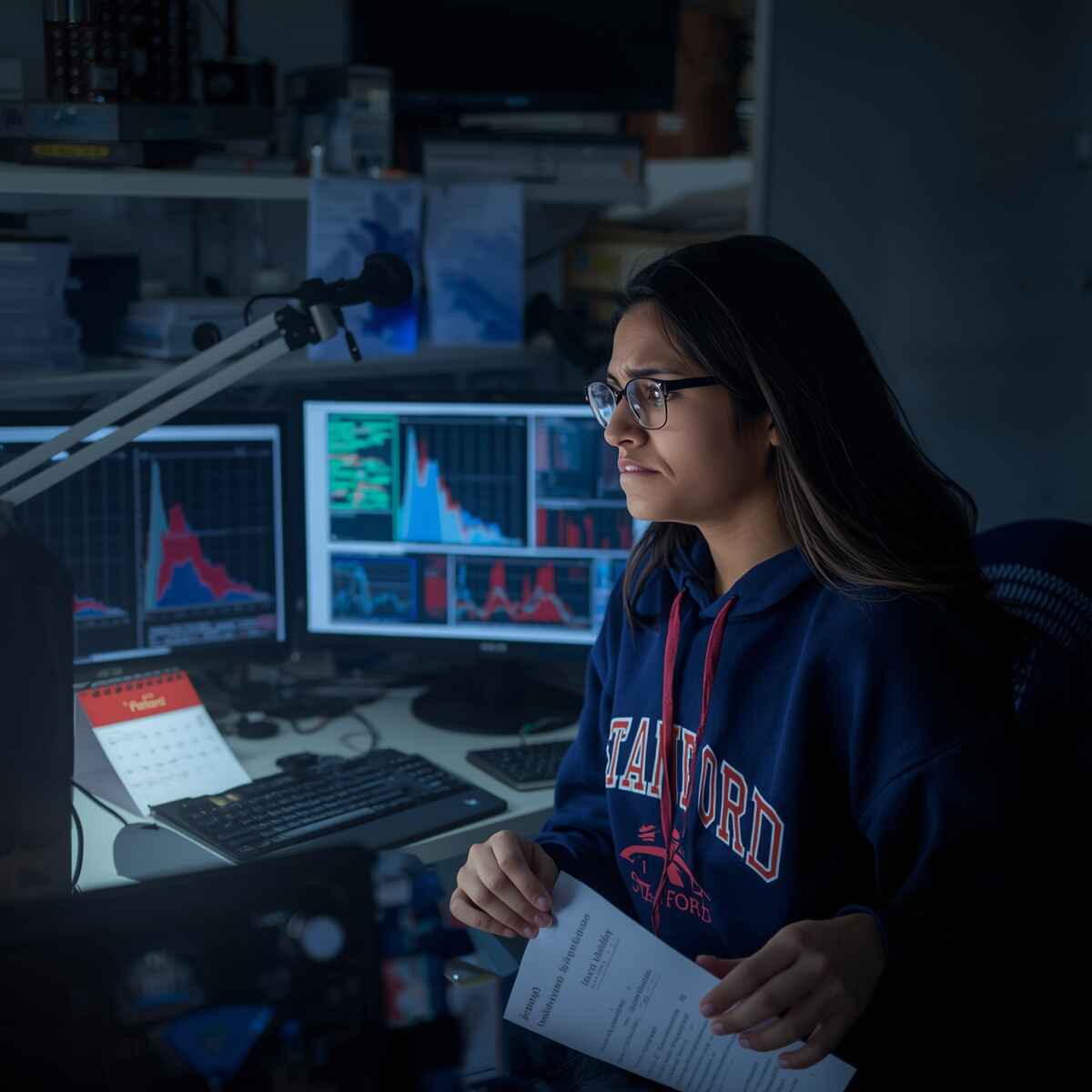
Update April 2025: Good News
There’s finally some relief for international students. The Trump administration has officially withdrawn the proposal that would have capped F-1 visas with a strict four-year limit. This means Duration of Status (D/S) stays completely intact, just the way students and universities hoped.
For thousands of international Ph.D. students, this update brings a huge sense of peace and stability as they continue their long-term research and academic work in the U.S.
If you are an international student dreaming of a master’s or Ph.D. in the United States, you need to know about the F-1 visa 4 year limit that the Department of Homeland Security quietly proposed in 2024.
This single change could force thousands of graduate students especially in physics, engineering, computer science, and other research-heavy fields – to leave the country before finishing their degrees.
Here is exactly what’s happening, why it matters, and what it means for your future in america.
What is the F-1 Visa 4 Year Limit Proposal ?
Right now, F-1 students enjoy something called duration of status. As long as you’re enrolled full-time and making normal progress, you can stay in the U.S. until you graduate whether that takes 4, 5, 6, or even 7 years for a ph.D.
The New Rule: Strict 4 Year Cap
The New F-1 visa 4 year limit would completely eliminate that flexibility.
Under the DHS proposal, every F-1 visa would be issued for a maximum of four years only. After that, you must file Form I-539 for an extension with USCIS – a slow, expensive, and uncertain process. If your extension is not approved before your visa expires, you immediately fall out of status, even if you’re in the middle of your thesis defense.
This F-1 visa 4 year limit would affect hundreds of thousands of students, but it hits STEM Ph.D. students the hardest.
Why the F-1 Visa 4 Year Limit Is a Disaster for STEM Ph.D. Students
- The average physics Ph.D. in the United States takes 6.1 years.
- Mechanical engineering: 5.8 years.
- Electrical engineering: 5.7 years.
- Computer science: 5.5 years.
(Source: National Science Foundation Survey of Earned Doctorates 2023)
That means under the F-1 visa 4 year limit, almost every international STEM Ph.D. student would be forced to apply for an extension and pray it gets approved in time.
Student Voice: Indian Materials Science Ph.D.
One Indian materials science Ph.D. student at a top-20 U.S. university told me privately:
Four years is a joke for experimental work. My first two years were just learning how to use the equipment and fixing things that kept breaking. Real data only started coming in year three. If this F-1 visa 4 year limit passes, I honestly don’t know how I’ll finish.
Professor Voice: Texas A&M Physics Department
A tenured physics professor at a large Texas university said:
I have never – not once in 22 years – seen a student finish a real research-based physics Ph.D. in four years. It’s impossible. Research is unpredictable. If this F-1 visa 4 year limit goes through, we will stop recruiting international students. It’s too risky for them and for us.
Real Stories from Students Facing the F-1 Visa 4 Year Limit
Maria, a Brazilian Ph.D. candidate in chemistry (currently in year 5):
I came to the U.S. because this lab has equipment you can’t find anywhere else in Latin America. If the F-1 visa 4 year limit had existed when I applied, I would have gone to Germany or Switzerland instead.
Wei, a Chinese electrical engineering student (year 6):
My advisor told me last week that if the F-1 visas 4 year limit becomes real, the department will start preferring domestic students. It hurts to hear that after I’ve given everything to this program
Ahmad, an Iranian postdoctoral researcher on J-1 (also affected):
The uncertainty is killing productivity. We’re scared to publish anything even slightly controversial now. One wrong keyword in a paper, and you can lose your visa tomorrow.
The Bigger Picture: America Could Lose Its Best Talent
According to the National Science Board’s 2024 report, 70% of international Ph.D. graduates in science and engineering stay in the United States after graduation and power American innovation.
If the F-1 4 year limit pushes them away, countries like Canada, Germany, Australia, and the UK are ready to welcome them with open arms and much friendlier visa policies.
- Canada already extended post-graduation work permits to three years for everyone.
- Germany offers an 18-month job-search visa after graduation.
- Australia just announced a four-year post-study work visa for Ph.D. graduates.
Meanwhile, the U.S. is talking about the F-1 4 year limit.
As one Caltech professor put it:
This isn’t just bad for students. It’s national self-sabotage.
Current Status of the F-1 Visa 4 Year Limit
The public comment period closed in October 2024.
Over 40 scientific societies, including the American Physical Society, filed strong opposition.
A federal lawsuit has been filed against DHS by university presidents and higher education alliances.
No final decision has been announced yet.
But DHS has already started enforcing stricter rules in other ways – random visa cancellations, suspended interviews in certain countries, and a new $100,000 premium processing fee for H-1B in some cases.
What Should You Do Right Now?
If you’re planning to apply for fall 2025 or later:
- Seriously consider Canada, UK, Germany, or Australia as backup options.
- Choose master’s programs that can realistically be finished in 2–3 years (safer under the potential F-1 visa 4 year limit).
- If you must do a U.S. Ph.D., target programs with strong funding and a proven track record of fast completion (under 5 years).
- Start building connections in Europe/Canada early – just in case.
Official DHS Proposed Rule (must-read):
https://www.federalregister.gov/documents/2024/08/27/2024-17063/improving-the-nonimmigrant-student-regulations
Final Thoughts
The F-1 4 year limit is not law yet – but it’s the biggest threat international graduate students have faced in decades.
America has always attracted the world’s brightest minds because it offered opportunity and stability. If the F-1 4 year limit becomes reality, that reputation will take years to repair.
The choice is simple: fix the visa system and keep leading the world in science, or watch the next generation of Einsteins, Sundar Pichais, and Elon Musks build their futures somewhere else.


[…] READ MORE: F-1 Visa 4 Year Limit: The New Rule That Could Change International Graduate Education Forever […]